Head and Shoulders Pattern
The head and shoulders (H&S) pattern is a reversal formation that develops at the end of a bullish trend and signals a potential reversal.For a bearish trend, there is a corresponding pattern — the inverse head and shoulders — which we will discuss below.
Contents:


Pattern Description
The H&S pattern consists of a left peak, called the left shoulder, a middle peak, called the head, and a right peak, called the right shoulder.A key feature of this formation is that the head (the middle peak) must be higher than the left and right shoulders (the side peaks). The heights of the left and right shoulders relative to each other are usually slightly different, and this is normal.
Between the left shoulder and the head, as well as between the right shoulder and the head, there are minima, which often have different extremes. A line is drawn through these two minima, called the neckline. The neckline is very important, as it acts as a support level.
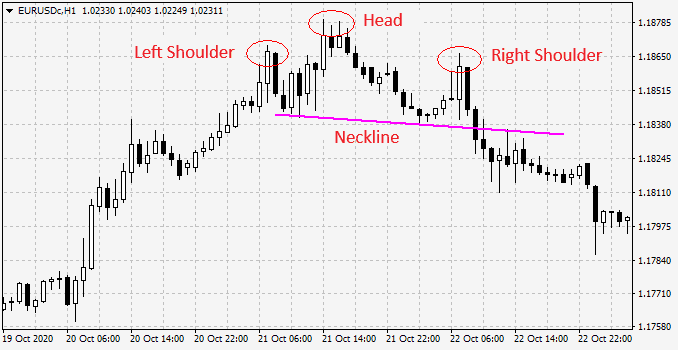
It is important to understand that the H&S pattern on the chart should look natural and clearly resemble a head with shoulders (three peaks). If the pattern appears incorrect, it’s better not to trade it.
Inverse Head and Shoulders
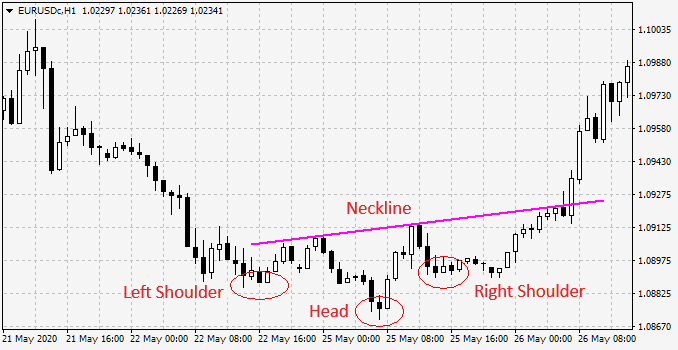
The inverse head and shoulders pattern forms at the end of a bearish trend and is a mirror image of the H&S pattern discussed above. Everything is arranged exactly the same, but upside down, and in this case, the neckline acts as a resistance level.
How to Trade the Head and Shoulders Pattern
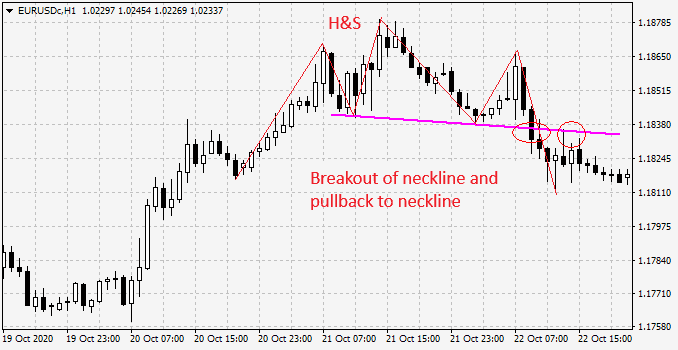
It is generally preferable to trade the H&S pattern on the neckline breakout. You can enter a trade at the moment of the breakout, but since this is a fairly large pattern, it is usually better to wait for the pullback to the neckline before opening a trade.
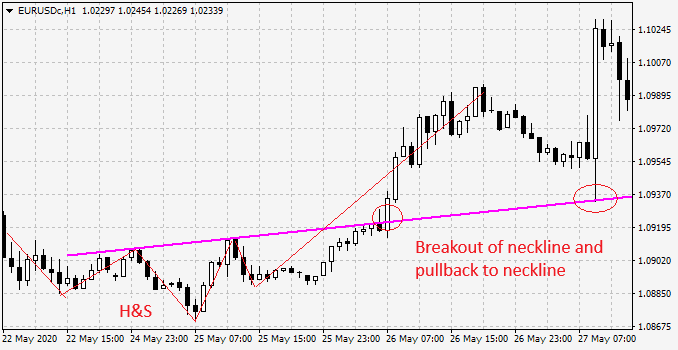
When trading the inverse H&S pattern, a trade is opened either at the neckline breakout or on the subsequent pullback to it.





 Reviews:
 Reviews:
 Reviews:
 Reviews: