Triangle Pattern
Triangle pattern is one of the most common chart formations in trading. Visually, it appears as a narrowing or expanding price range. This pattern may form during a trend, in a sideways market, or within a correction.A triangle is formed using at least two swing highs and two swing lows on each side, which define the boundaries of the narrowing or expanding price range.
Contents:


Triangles can take various shapes, slopes, and directions. In this article, we will examine all types of triangles: symmetrical, broadening, ascending, and descending.
Symmetrical Triangle
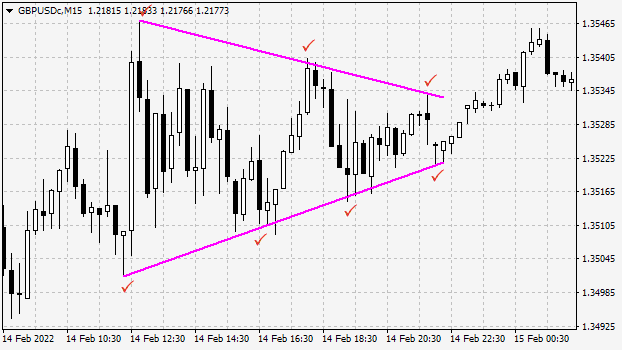
The symmetrical (converging) triangle forms as the size of each successive price swing in the range decreases.
Broadening Triangle
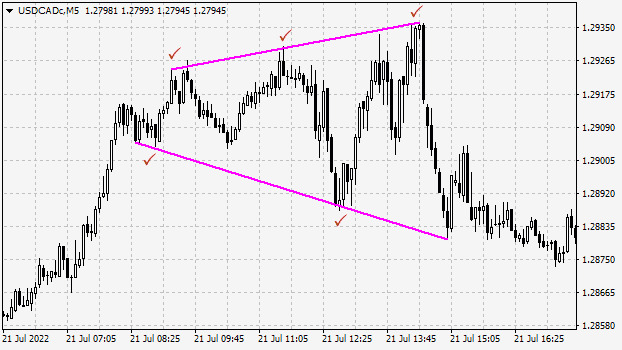
The broadening triangle forms as the size of each successive price swing in the range increases.
Ascending Triangle
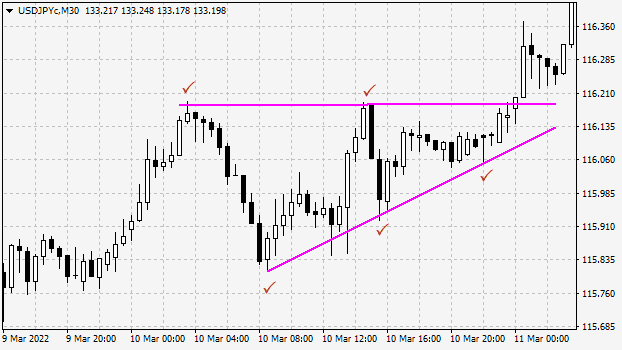
The ascending triangle forms as the size of each successive swing at its lower part (at the support level) decreases. The upper part of the ascending triangle is horizontal or slightly sloped upwards, constrained by the resistance level.
Descending Triangle
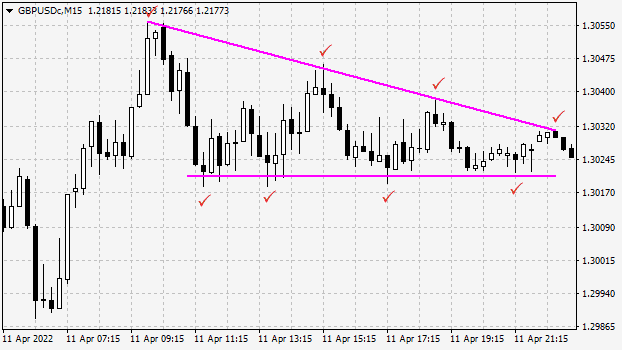
The descending triangle forms as the size of each successive swing at its upper part (at the resistance level) decreases. The lower part of the triangle is constrained by the support level; it remains horizontal or is slightly sloped downwards.
How to Trade the Triangle Pattern
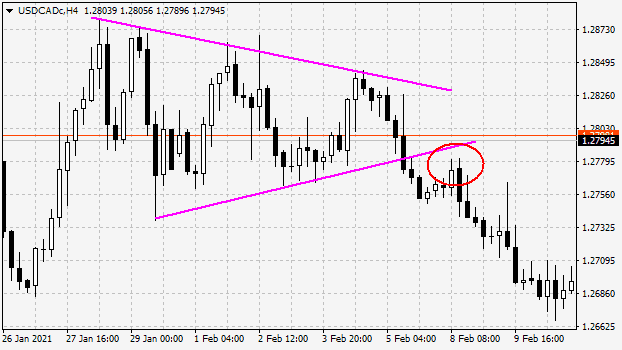
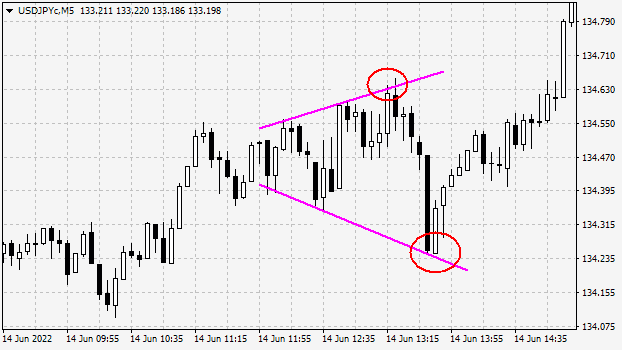
Triangles are usually traded on a breakout, with the exception of the broadening triangle, which can also be traded on a bounce back from the triangle’s boundaries.When trading a breakout, an order can be opened at the moment of the breakout, or one can wait for a pullback to the breakout level and then look for an entry into the trade.
The triangle breakout, entry on the pullback to the breakout line occurs at the marked point.
The entry on the bounce inside the triangle occurs at the marked points.
Related Posts:
Comments


Eugene 2025-12-08 19:34:20 #
It’s better to let the triangle fully form and wait for the price to break out. I do not recommend opening trades while the triangle pattern is still forming.

DoTZ 2026-02-21 13:15:24 #
That’s your personal opinion! In a broadening triangle, I like to open trades on the third or even fourth touch, inside the triangle, anticipating a breakout of the opposite boundary and the price to continue in the trend.



 Reviews:
 Reviews:
 Reviews:
 Reviews: