Channels in Trading
Trading channels are a fairly old tool, forming the basis of many strategies that remain popular among traders to this day.Contents:
Let’s take a closer look at how channels are formed, how to draw them on a chart, and how to trade using them.
An equidistant channel is formed by two parallel lines drawn through consecutive lows and highs of the price. Channels can be sloping (ascending and descending) and horizontal.


Sloping Channel
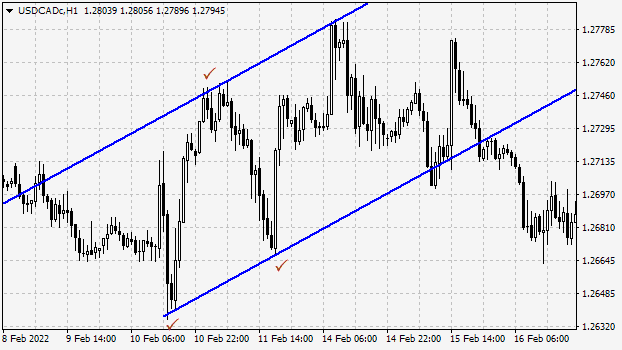
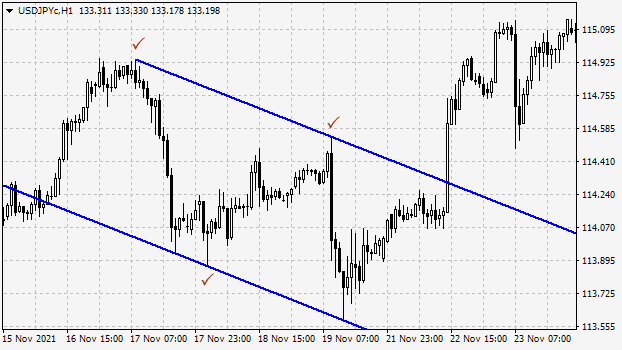
A sloping channel can be ascending (bullish) or descending (bearish). To construct an equidistant channel, three points are required — local highs and lows of the price.The first channel line is drawn through two points (two extrema) located on one side of the price movement, while the second line is drawn parallel to the first through the third point (extremum) on the opposite side.
There can be more points used to construct the channel if it is an older channel, but when a channel is just forming, it is usually built using three points.
The ascending channel on the chart.
The descending channel on the chart.
Essentially, a channel is a trend line with an additional parallel line drawn on the opposite side of the price movement.
Horizontal Channel
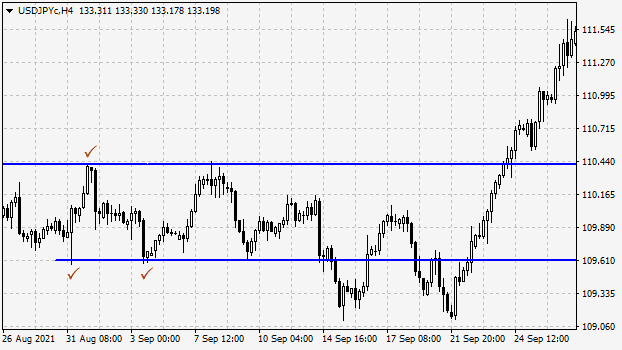
A horizontal channel is constructed in a horizontal plane using consecutive highs and lows positioned on both sides of the price movement. However, in practice, you rarely encounter a perfectly horizontal channel.The horizontal channel on the chart.
How to Trade Using Channels
In most cases, channels are traded on a rebound — from the inner boundary of the channel. A stop loss is placed just beyond the candle testing the channel line or at a short distance from it. Take profit is set at the opposite boundary of the channel.
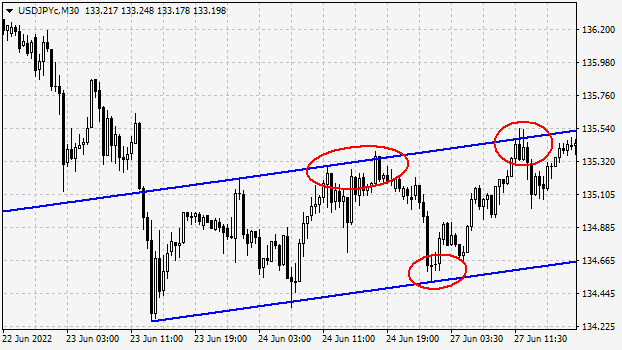
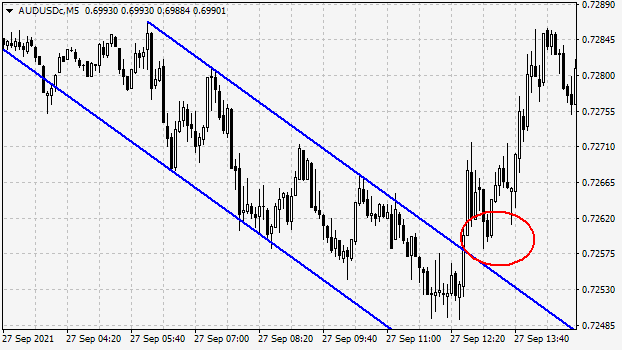
If the channel breaks, an entry can be considered when the price returns to the outer channel boundary in the direction of the breakout.





 Reviews:
 Reviews:
 Reviews:
 Reviews: