Gaps in Trading
Gaps can be observed on charts across all markets, including Forex, stocks, and futures. In some markets, gaps occur more frequently, while in others they are less common; however, there is no market where gaps do not occur at all.What Is a Gap
A gap is a price gap from the closing price of one candle or bar to the opening price of the next. It occurs when the closing price does not match the opening price of the following candle.Gaps are visible on charts using Japanese candlesticks or bar charts. They do not appear on line charts, Renko charts, or Kagi charts.


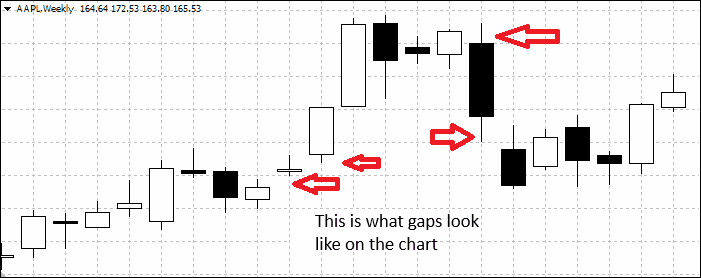
Why Gaps Occur
Gaps can be classified into two types:- Intraday gaps – gaps that occur within a single trading session.
- Inter-session (overnight) gaps – gaps that form between the close of one session and the open of the next.
Intraday Gaps
Intraday gaps are relatively rare and typically occur due to unexpected economic or political news that can significantly affect prices, such as:- Interest rate announcements from major central banks
- Updates on unemployment levels
- US business activity indexes and other key economic indicators
Inter-session (Overnight) Gaps
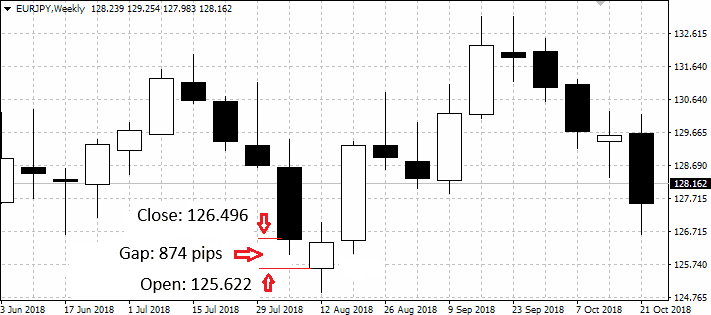
Inter-session gaps occur frequently and can be found in all markets. They appear at the opening of a new trading session at a price that differs significantly from the closing price of the previous session. This happens because, during non-trading hours, the market may be influenced by unexpected economic or political news, which can drastically shift the opening price.Gaps on Forex
The Forex market operates continuously from the first trading hour on Monday to the last trading hour on Friday. As a result, gaps usually form over the weekend. Inter-session gaps are very rare, and when they do occur, they are typically quite small.
Gaps on Stocks
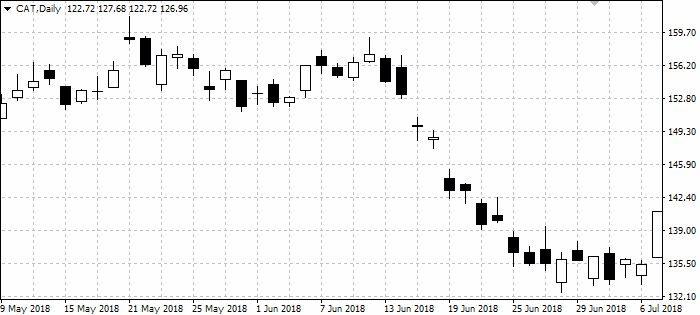
Gaps in stocks occur quite frequently because stock markets open in the morning and close in the evening of each trading day, Monday through Friday. As a result, gaps can form daily, as well as over the weekend, between the close on Friday and the open on Monday.
How to Trade Gaps
Can you profit from gaps? Yes, it is possible, but this mainly applies to weekly gaps on Forex. Gaps on stocks cannot be traded using Forex strategies. Let’s look at a simple strategy so you can get an idea of how to trade gaps.Forex Gap Trading Strategy
Statistically, 90–95% of gaps get filled, meaning the price eventually moves to close the gap. For example, if the EUR/USD pair closed at 1.13190 on Friday evening and opened at 1.13495 on Monday, the price is likely to move downward until the gap is fully filled.
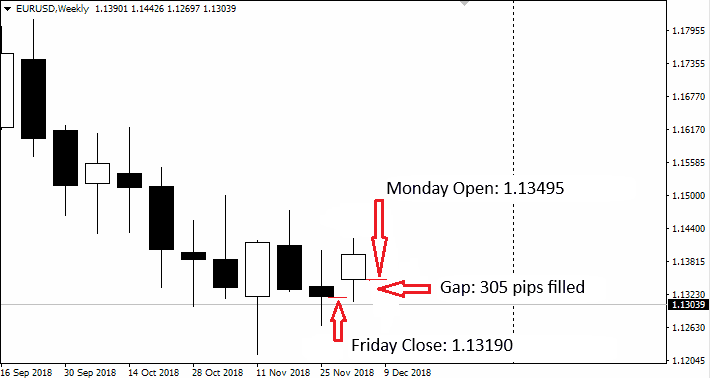
Trading should be done in the direction of gap filling, so trades should be opened according to the following rules (for 5-digit quotes):
- If the market opens above the previous close, only consider selling; if it opens below, only consider buying.
- Only gaps of at least 150–200 pips should be considered for trading.
- Take profits 30–50 pips before the Friday closing price.
- A stop-loss must always be set, either at the nearest level or equal to the expected profit.
If the gap exceeds 500 pips (for 5-digit quotes), take-profit should be set at the 50% level. Such a large gap is usually triggered only by significant economic or political data, which can have a major impact on the price chart and even change the trend. Nevertheless, there is a high probability that at least 50% of the gap will be filled.
Related Posts:
Comments


2Tuazr 2025-12-20 15:44:37 #
There are no gaps in cryptocurrencies, particularly on exchanges where crypto trades 24/7 without any breaks.

MXN 2025-10-18 21:59:58 #
I only know one forex gap trading strategy - it’s based on the idea that prices will usually fill the gap between friday and monday, which often happens. Are there any other effective ways to trade gaps?



 Reviews:
 Reviews:
 Reviews:
 Reviews: